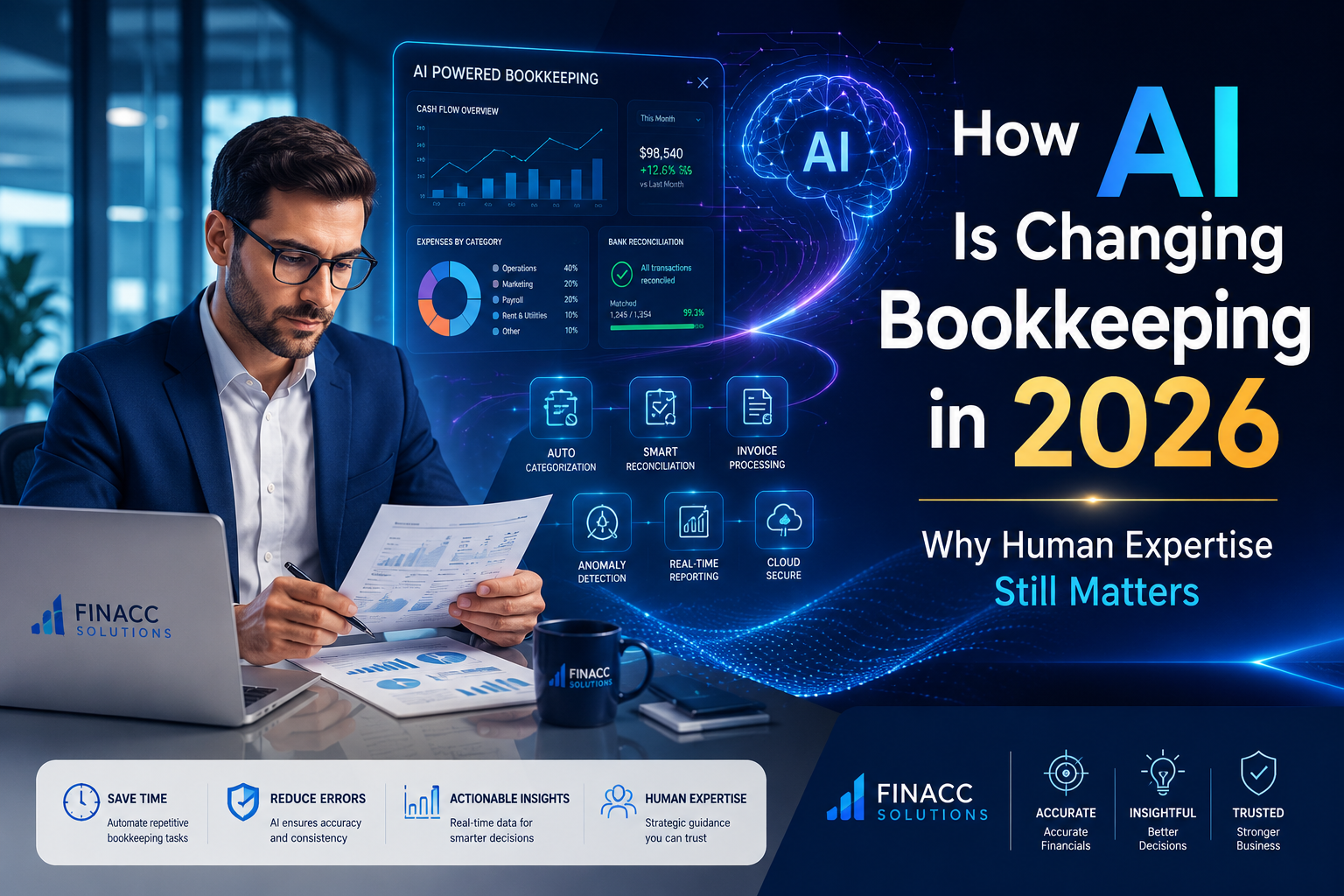
If you run a business in the US, you've probably noticed the shift. Your accounting software now suggests categories before you finish typing. Bank feeds reconcile themselves. Invoices get read, coded, and filed without anyone touching a keyboard. AI bookkeeping has quietly become part of everyday financial management — and if you're not using it yet, your competitors probably are.
But here's the question we hear most from business owners: if AI can do the books, why do I still need an accountant?
The honest answer, backed by the latest 2026 industry data, is that AI is changing what accountants do — not whether you need one.
What AI Bookkeeping Tools Are Actually Doing Well in 2026
AI tools have gotten genuinely good at the repetitive, rules-based parts of bookkeeping:
Bank reconciliation — largely automated, with most transactions matched without human input Invoice and receipt processing — AI now reads, extracts, and codes the bulk of incoming documents Transaction categorization — routine entries get sorted automatically, with only exceptions flagged for review Fraud and anomaly detection — patterns that would take a person hours to spot get flagged in seconds
A widely cited MIT Sloan and Stanford study of firms using AI bookkeeping tools found that accountants shifted a meaningful chunk of their time away from manual data entry toward higher-value work, ledger detail improved, and month-end close cycles got noticeably faster. That's a real, measurable gain — not hype.
Recent industry surveys back this up. Roughly half of accounting professionals now use AI features in their day-to-day software, and the large majority of those who use it report a positive return, citing fewer errors and faster turnaround.
Where AI Still Falls Short in Accounting — And Why That Matters to You
Here's what the data also shows, consistently, across nearly every major 2026 industry report: AI is not replacing the judgment side of accounting.
Tasks that remain firmly human include:
Interpreting unusual or ambiguous transactions Making tax and compliance decisions that carry legal or financial liability Spotting when a client's numbers "look right" but something is actually off Advising on cash flow, growth planning, and strategic decisions Communicating with banks, investors, or regulators on your behalf
One point that comes up again and again in industry research: AI is statistically likely to be right, but "statistically likely" isn't the same as compliant with accounting standards or defensible to the IRS. That gap is exactly where a human accountant earns their fee.
It's also worth noting that despite widespread AI adoption, very few finance leaders report that it has fundamentally transformed their operations yet. The tools are powerful, but they still need someone experienced steering them, checking their output, and catching the exceptions.
What AI in Accounting Means for Your Business
For US business owners working with outsourced accounting teams, this shift is actually good news. It means:
Faster turnaround on routine work. Reconciliations, categorization, and reporting can happen quicker than ever, so you're not waiting weeks for clean books. Lower risk of manual error. Automation catches typos and mismatches a tired human might miss. More time spent on strategy, not data entry. The hours saved on routine tasks get redirected into forecasting, reporting insights, and advisory conversations — the parts of accounting that actually help you make decisions. More reason to choose a partner, not just a tool. Software alone won't flag a misclassified expense that skews your tax position, or notice that your gross margin trend signals a pricing problem. That still takes a trained eye — the same reasoning that applies to more complex work like group consolidation across multiple entities. FAQ: AI and Bookkeeping in 2026
Will AI replace bookkeepers? No. AI is automating routine, rules-based tasks like data entry and reconciliation, but review, exception handling, tax judgment, and client advisory work remain human-led. The role is shifting toward supervising AI output rather than disappearing.
Is AI bookkeeping accurate enough to trust without review? AI significantly reduces manual errors, but it still requires human oversight. Unusual transactions, missing documentation, and compliance decisions need a trained accountant to review AI-generated entries before they're finalized.
Should my small business start using AI accounting tools in 2026? Yes, if they're paired with human oversight. AI can speed up reconciliation and data entry, but pairing it with an experienced bookkeeper or outsourced accounting team ensures accuracy and compliance.
What accounting tasks will AI take over first? Bank reconciliation, invoice processing, and basic transaction categorization are the most automated tasks today. Complex tax planning, financial strategy, and audit judgment remain largely human.
The Bottom Line
AI isn't coming for your bookkeeper's job — it's coming for the parts of the job nobody enjoyed anyway: the data entry, the manual matching, the repetitive coding. What's left is the part that actually adds value: judgment, strategy, and accountability.
At FinAccSolutions, we use modern AI-powered tools to handle the routine work efficiently — but every set of books is still reviewed, interpreted, and backed by a real accountant who understands your business. That combination — smart automation plus experienced oversight — is what keeps your financials accurate, compliant, and actually useful for decision-making.
Looking for a bookkeeping partner who combines AI-driven efficiency with real accounting expertise? Get in touch with FinAccSolutions to see how we can streamline your books without losing the judgment that keeps you compliant and informed.